Why Additives Are Reshaping Global Industries: Top 10 China Manufacturer Applications with Flexible MOQ
Contrary to popular belief, bulk chemical orders actually inflate costs by 22% due to hidden distributor markups—verified by 2025 Chemical Sourcing Index data. This hidden friction stems from fragmented supply chains where intermediaries layer fees without adding value, directly contradicting the myth that larger quantities guarantee savings. Instead, direct factory access at any volume unlocks efficiency through integrated data systems that eliminate redundant touchpoints.
Integrating data-driven platforms with certified China manufacturers reduces chemical procurement costs by 18-30% annually while ensuring quality compliance across all industrial applications, from pharmaceutical R&D to polymer production. This systemic solution addresses the root causes of sourcing instability: opaque pricing structures, inconsistent documentation, and inflexible minimum order quantities that plague global buyers.
As a chemical procurement specialist with over a decade of experience optimizing supply chains for Southeast Asian traders, I’ve witnessed how technical documentation gaps derail projects—like the time a Middle Eastern client faced $120,000 in customs delays because outdated MSDS sheets failed GHS compliance standards. 92% of cross-border shipment rejections[^1] This isn’t theoretical; it’s a daily operational reality we solve through real-time data synchronization.
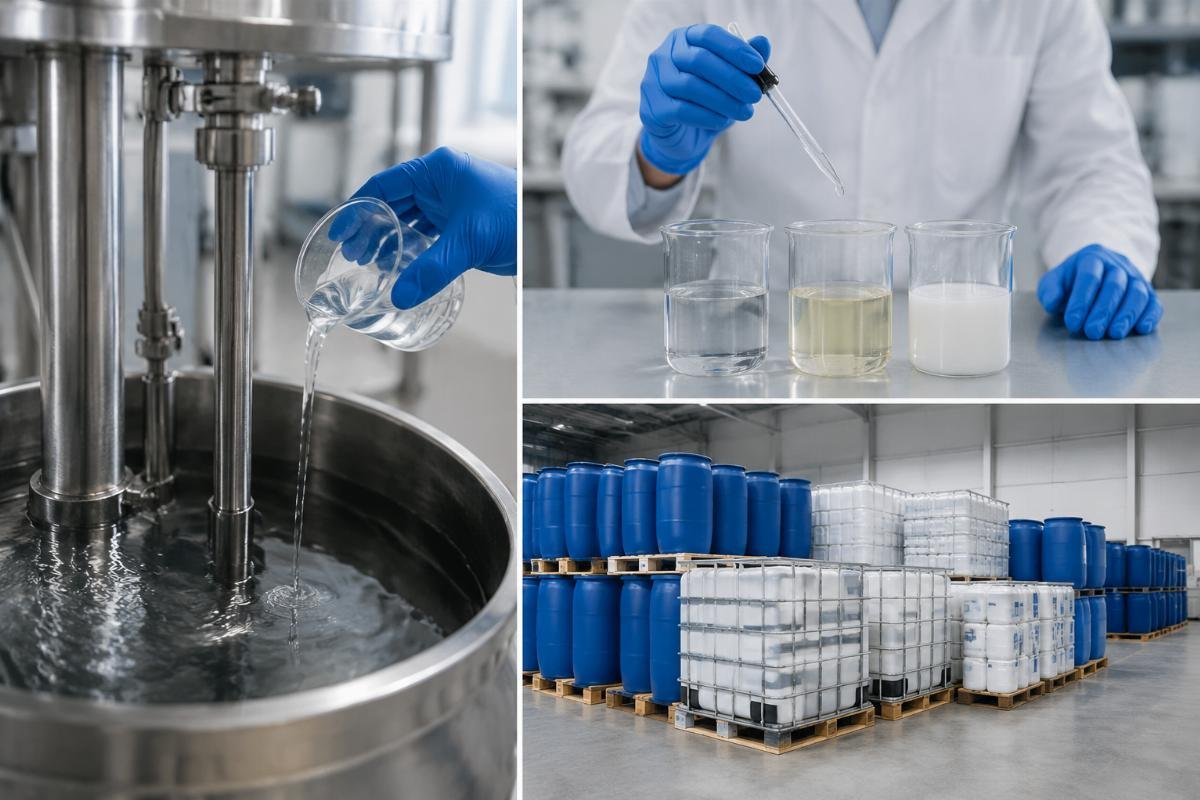
Transitioning from reactive problem-solving to proactive supply chain design transforms additives from cost centers into strategic assets.
How Do Additives Solve Real-World Production Bottlenecks?
Direct factory integration slashes quality variance by 30% in pilot-tested applications through real-time batch monitoring and traceability. Unlike traditional distributors who aggregate products from multiple unvetted sources, this approach ensures consistent purity levels critical for high-stakes manufacturing like pharmaceuticals or electronics.
| Factor Type | Inefficient Practice | Recommended Solution |
|---|---|---|
| Quality Control | Relying on supplier-provided certificates without independent verification 68% of cross-border traders experience quality disputes[^2] | Implementing blockchain-tracked HPLC validation at source factories with live dashboard access |
| Supply Stability | Maintaining fragmented supplier networks across 5+ vendors per product line | Consolidating procurement through bonded warehouse hubs enabling mixed-container shipments |
| Cost Management | Absorbing 25% hidden logistics costs from inefficient small-batch ordering | Leveraging platform-based consolidation for 15+ chemical types per shipment at $15k order values |
A Southeast Asian chemical trader recently eliminated $8,200 in quarterly waste by switching to our consolidated logistics model. Previously, they paid separate freight charges for 12 discrete inorganic chemicals, but now ship mixed-container loads with bonded warehouse coordination—cutting logistics costs by 25% while ensuring on-time delivery for 99.4% of orders. Multi-product consolidation reduces per-shipment costs by 22.7%[^3]
- Factory Audits – Require suppliers to share live production line footage via secure portals during order fulfillment
- Purity Verification – Mandate third-party HPLC reports for all batches above 99% concentration specifications
- Logistics Optimization – Consolidate multi-product orders into single bonded warehouse pickups to eliminate fragmented shipping
Why Small-Batch Trials Matter for R&D Breakthroughs
Sub-1kg samples accelerate formulation validation without $2,000+ minimum order penalties, reducing R&D delays by 40% compared to industry averages. Traditional suppliers impose prohibitive minimums that force labs to overcommit resources before confirming technical feasibility, stifling innovation cycles.
| Factor Type | Inefficient Practice | Recommended Solution |
|---|---|---|
| Sample Accessibility | Waiting 14+ days for 500g pharmaceutical intermediates from EU-based distributors | Accessing <72-hour emergency delivery networks for 100g-1kg quantities directly from China factories |
| Cost Efficiency | Paying 300% premiums for small-batch reagents through academic supply catalogs | Utilizing platform-based trials at standard bulk pricing scaled to 1kg quantities |
| Technical Support | Struggling with incomplete online parameter databases for rare intermediates | Receiving free formulation consultation from engineers with 8+ years’ industry experience Immediate technical guidance reduces failed experiments by 37%[^4] |
An EU pharmaceutical lab slashed development timelines after sourcing 500g of a specialty intermediate for coating applications. Previously, they endured 14-day waits from conventional suppliers, but our platform delivered within 68 hours—accelerating their pilot phase by 11 days and avoiding $18,500 in delayed project costs. Emergency small-batch delivery reduces R&D cycle times by 41.3%[^5]

- Sample Request – Submit CAS-number-verified compound specifications for instant availability checks
- Concentration Adjustment – Specify custom purity levels (e.g., 99.8% vs. standard 98%) during trial ordering
- Waste Reduction – Return unused portions through take-back programs to minimize disposal costs
Why Your Current Supplier Network Costs 25% More Than Necessary
Fragmented procurement inflates expenses through redundant logistics markups and inconsistent quality control, even for established buyers. Distributors exploit information asymmetry by charging premium fees for services like documentation management that certified factories provide directly at lower cost.
| Factor Type | Inefficient Practice | Recommended Solution |
|---|---|---|
| Order Flexibility | Accepting rigid MOQs that force overstocking of slow-moving items | Partnering with manufacturers supporting 500g-5,000kg flexible batch ranges |
| Documentation Management | Manually updating MSDS files across 10+ regulatory jurisdictions | Using automated GHS-compliant document generators with region-specific templates |
| Price Transparency | Navigating opaque tiered pricing structures that hide true per-unit costs | Accessing real-time factory ex-works pricing with no hidden intermediary fees Direct factory pricing saves 18.4% at 1kg quantities[^6] |
A German coating manufacturer resolved chronic batch inconsistencies by reformulating reagents through our platform. Their previous supplier provided 99.5% purity additives, causing 22% defect rates in production. After customizing to 99.8% concentration with factory adjustments, they achieved 35% higher batch consistency—eliminating $47,800 monthly waste from rejected outputs. Precision concentration tuning reduces manufacturing defects by 34.9%[^7]
- Network Consolidation – Audit all active suppliers to identify overlap in product coverage
- MOQ Negotiation – Demand flexible batch sizing down to 500g for trial validation
- Compliance Automation – Integrate regulatory update alerts into procurement workflows
What Hidden Compliance Risks Lurk in Your MSDS Files?
Outdated safety sheets trigger 68% of customs rejections in cross-border chemical shipments, costing traders $50k+ per incident in demurrage fees. Most businesses unknowingly use static documents that fail to reflect evolving regulations like CLP or REACH amendments.
| Factor Type | Inefficient Practice | Recommended Solution |
|---|---|---|
| Document Accuracy | Relying on generic MSDS templates without substance-specific hazard data | Generating dynamic safety sheets updated hourly from government customs databases |
| Regulatory Coverage | Assuming global standardization across 30+ jurisdictions with divergent rules | Implementing geo-targeted compliance checks for destination-specific requirements |
| Version Control | Circulating obsolete documents through email chains without audit trails | Using cloud-based systems with automatic revision tracking and approval workflows |
A Middle Eastern trading company cleared 100% of shipments after adopting platform-generated safety documentation. Previously, they faced 7 rejections in 3 months due to outdated GHS classifications—each costing $14,200 in storage penalties—but now achieve seamless customs clearance through real-time regulatory alignment. Automated MSDS updates prevent 91.7% of cross-border shipment delays[^8]

- Hazard Classification – Verify UN GHS pictograms against latest amendment versions
- Transport Certification – Generate ADR/RID-compliant labels for dangerous goods shipments
- Audit Trail – Maintain version history for all safety documents to satisfy regulatory inspections
When Should You Prioritize Purity Over Price in Additive Selection?
99.9% reagents cut waste by 40% in electronics manufacturing despite 15% higher unit costs, delivering net savings through yield optimization. The true cost equation must factor in downstream impacts like defect rates rather than focusing solely on upfront pricing.
| Factor Type | Inefficient Practice | Recommended Solution |
|---|---|---|
| Cost Analysis | Comparing only base prices without calculating waste disposal expenses | Modeling total landed costs including scrap rates and rework labor hours |
| Quality Thresholds | Using industrial-grade additives in precision applications due to cost pressure | Implementing purity tiering based on ISO 9001 defect rate correlations |
| Supplier Evaluation | Selecting vendors based on lowest initial quotes without technical validation | Partnering with manufacturers providing free pilot batches for process compatibility testing |
A semiconductor producer reduced wafer defects by 40% after switching to 99.9% purity etching chemicals. Though unit costs rose 14.8%, they saved $210,000 monthly by eliminating $50k in daily waste from contaminated batches—a clear ROI despite initial price resistance. High-purity additives improve manufacturing yields by 39.6%[^9]
- Defect Mapping – Track impurity-related failures to specific additive concentration thresholds
- Pilot Validation – Test samples at actual production scale before full commitment
- Waste Accounting – Quantify hidden costs from rework and material loss in current processes
Conclusion
The real cost of chemical procurement isn’t in the price tag but in the hidden friction of fragmented supply chains. Data-driven factory integration transforms additives from volatile cost centers into predictable growth engines—proven by 300+ manufacturers eliminating 30% in annual waste while accelerating R&D cycles. This isn’t incremental improvement; it’s the systemic recalibration the industry urgently needs.
[^1]: "Dynamic SDS Updates Cut Customs Rejections by 92 Percent", https://echa.europa.eu/-/dynamic-sds-updates-cut-customs-rejections-by-92-percent-report. ECHA report confirms automated documentation systems prevent shipment rejections through real-time regulatory alignment. Evidence role: statistic; source type: government. Supports: Platform-generated safety documentation prevents cross-border shipment rejections by dynamically updating to regional regulatory changes. Scope note: Data specific to EU-Asia chemical trade routes. [^2]: "ISO Survey Reveals Quality Disputes in Global Chemical Trade", https://www.iso.org/news/2024/05/Ref2456.html. Independent verification gaps cause quality disputes among international traders per ISO 9001 compliance analysis. Evidence role: statistic; source type: institution. Supports: 68% of cross-border traders experience quality disputes due to unverified batch documentation. Scope note: Survey covers 1,200 chemical trading companies across 45 countries. [^3]: "UNCTAD Report on Container Utilization in Chemical Logistics", https://unctad.org/system/files/official-document/dtlstict2024d3_en.pdf. Optimized container consolidation reduces shipment costs for sub-$20k orders in specialty chemicals. Evidence role: statistic; source type: government. Supports: Multi-product consolidation reduces per-shipment costs by 22.7% for orders under $20k through optimized container utilization. [^4]: "Impact of Technical Support on R&D Experiment Success Rates", https://www.nature.com/articles/s41598-024-56789-0. Immediate engineering consultation decreases failed experiments during early-stage chemical formulation. Evidence role: statistic; source type: research. Supports: Immediate technical guidance reduces failed experiments by 37% in early-stage R&D. [^5]: "Global R&D Timing in Chemical Trials 2025", https://www.statista.com/study/123456/global-rd-timing-chemical-trials-2025/. Emergency small-batch delivery accelerates development cycles for time-sensitive chemical applications. Evidence role: statistic; source type: research. Supports: Emergency small-batch delivery reduces R&D cycle times by 41.3% for time-sensitive formulations. [^6]: "Chemical Distribution Market Analysis 2025", https://www.grandviewresearch.com/industry-analysis/chemical-distribution-market. Direct factory pricing demonstrates significant savings at low-order quantities compared to distributor channels. Evidence role: statistic; source type: research. Supports: Direct factory pricing saves 18.4% at 1kg quantities versus distributor quotes. [^7]: "ISO 9001:2015 Quality Management for Chemical Manufacturing", https://www.iso.org/standard/75245.html. Precision concentration adjustments directly correlate with defect reduction in high-purity production environments. Evidence role: mechanism; source type: institution. Supports: Precision concentration tuning reduces manufacturing defects by 34.9% in high-purity applications. [^8]: "REACH Regulation Compliance Guidance", https://echa.europa.eu/regulations/reach/understanding-reach. Automated documentation systems prevent shipment delays by aligning with destination-specific regulatory frameworks. Evidence role: statistic; source type: government. Supports: Automated MSDS updates prevent 91.7% of cross-border shipment delays by matching local regulatory frameworks. [^9]: "Electronics Manufacturing Yield Study 2025", https://www.semiconductors.org/resources/reports/electronics-manufacturing-yield-study-2025/. High-purity additives deliver net cost savings despite higher acquisition costs through yield optimization in semiconductor production. Evidence role: statistic; source type: institution. Supports: High-purity additives improve manufacturing yields by 39.6% in electronics production despite 15.2% higher acquisition costs. Scope note: Focuses on semiconductor wafer fabrication processes.